
K-Dramas Become More Korean
What are the most Korean things for the global audience? BTS, “Squid Game,” K-beauty; kimchi still deserves a place, and, of course, the Oscar-winning “KPop Demon Hunters.” In the recent Korean drama (K-drama) “In Your Radiant Season” on Disney+, the perfectionist, LGBTQ+ designer Je Rae-mi says, “The most Korean things are what end up being popular worldwide,” referring not to any K-pop groups, but to the Korean color palette, dancheong (a coloring technique), and the hanbok (Korean clothing) panel. People might have been drawn into this drama by the cute leading stars, as I was, but they would later seek out traditional Korean arts and culture, and even book a trip to Gyeongju to experience hanok villages, as recommended by Travel + Leisure.
Traditional Korean elements once associated with historical TV shows are now highlighted and articulated in urban romance and melodrama. Dancheong, a Korean decorative coloring technique applied to wooden buildings and artifacts, which evolved from the Chinese painting practice danqing, becomes an important source of fashion inspiration when the characters develop an animation project in “In Your Radiant Season.” “Can This Love Be Translated?”, a 2026 Netflix rom-com series, features the main male character Joo Ho-jin living in a house inherited from his grandfather, filled with ancient books, paintings, and china. The recently concluded “Perfect Crown,” set in a fictional contemporary constitutional monarchy, outfits Grand Prince I-an in various hanbok-adapted suits. K-dramas, which have transcended geographical boundaries with their stylish obba, emotional appeal, and prosperous East-West fusion city life, are now reminding the global audience, especially in the West, of their Korean heritage.
Hallyu, or the Korean Wave, first swept East Asia at the turn of the millennium. KBS historical drama “Daejanggeum (Jewel in the Palace)” was the “Squid Game” of 2003, only more phenomenal, which reached 91 countries in an era prior to streaming platforms. A landmark K-drama remembered by Chinese audiences, its lead actress Lee Young-Ae even shook hands with former Chinese President Hu Jintao at a 2008 dinner for Chinese and South Korean leaders. With the popularity of “Daejanggeum,” Korean barbecue restaurants grew in China; clothing and accessory stores played the main soundtrack ‘Onara;’ my aunt went on a trip to Seoul, and she bought hanbok dresses for my cousin and me for Spring Festival — we didn’t even own a qipao at that time.
Hallyu 1.0 knocked on the door of middle-aged Asian women through a long series of historical dramas and family TV shows, thanks to cultural proximity. These shows feature strong family bonds and complex conflicts among relatives, amid Confucian etiquette and social hierarchy, themes common across many Asian regions. Entering the ‘10s, social media united teenage girls and young women from Japan, China, and Southeast Asia through their shared love of Super Junior, EXO, and Professor Do — a renowned male character from the 2013 SBS fantasy-romance miniseries “My Love from the Star.” K-pop and miniseries became the major driving forces of Hallyu 2.0, both depicting highly polished, attractive personas that seem to be close to you but are too good to exist in real life. At that time, online Asian fandom had gone crazy, while Korean pop culture was still considered niche in the U.S. market, especially given its hyperproduction, sexual restraint, and sleekness — qualities that American critics often view as less “authentic.” Comments changed when BTS topped the Billboard 200 in 2018. The new Korean wave has since blown in the U.S. and Europe, followed by an increase in K-pop idol appearances at Coachella post-pandemic.
Highly influenced by Western pop music, especially African-American genres, K-pop is often questioned for not being musically “Korean” enough. The group Katseye’s diverse nationalities and Blackpink’s 2026 comeback with an English mini-album, “Deadline,” further elevate the question of the “K” in K-pop. As an export-oriented product, K-pop’s manifestations of delocalization, or globalization, are not surprising. On the other hand, artists explicitly showcase their Korean pride with their increased international impact. BTS released their new studio album titled “Arirang” in March, named after Korea’s most famous folk song, which is recognized by UNESCO as an intangible cultural heritage. The HUNTR/X incorporated a kaleidoscopic opening of traditional drumming, vocals, and dance into their 2026 Oscar performance of 'Golden,' a phenomenal soundtrack in “KPop Demon Hunters.”
K-dramas, more local and nuanced than K-pop, often tell powerful emotional stories about modern Korean society, spanning social classes, while also enchanting fans with elements of fantasy and romance. These works consistently depict traditional Korean customs and ancient Asian philosophies such as Confucianism, Buddhism, and Taoism, which are deeply embedded in Korean society. However, they rarely articulated traditional culture as a key selling point, instead using Korea-West fusion items as business cards. The 2014 blockbuster “My Love from the Star” triggered the chimaek phenomenon — a combination of Korean fried chicken and maekju (beer) — because the heroine recommends a snowy day as the perfect time for chimaek. Modern chimaek is believed to have been invented in the late 20th century, rooted in Korean cuisine history and combining imported influences. A few years later, the Netflix series “Crash Landing on You” further highlighted chimaek's popularity in both North and South Korea, pairing it with a scene of the main couple experiencing the first snow in Pyongyang and developing a plotline around a chain chicken restaurant in Seoul.
As they shift from broadcast channels to streaming platforms, K-dramas have increasingly integrated subgenres and social themes popular worldwide. “Itaewon Class,” a 2020 revenge-themed romantic drama on Netflix, showcases marginalized figures in Korean society: a high school dropout as the protagonist, a sociopath, a transgender chef, and a Guinean-Korean part-timer. It was rare to see LGBTQ+ characters in previous K-dramas, let alone openly discuss their dilemma in society. In the 2018 series “What’s Wrong with Secretary Kim,” the protagonist’s mother expresses relief when the heroine confirms her son isn’t gay. Now in “In Your Radiant Season,” Je Rae-mi unapologetically asserts his identity, although the character further reinforces stereotypes about male homosexual groups — mean, effeminate, and exaggerated. As K-drama topics expand, veteran audiences also claim they have become more “Western,” favoring violence and thrillers, embracing political correctness, and diluting the meticulous emotional depictions. Some treat “Squid Game” more as a Hollywood-scale movie than as a K-drama.
The blended content has effectively expanded K-dramas’ reach via streaming platforms. One year after “Squid Game,” the overseas sales of K-dramas increased 29.6%. In March 2023, four of the top 10 non-English Netflix dramas were K-dramas. The rising global impact, in turn, has led K-dramas to more openly showcase their Korean identity. Packaging as many Korean elements as possible, “In Your Radiant Season” is reminiscent of a marketing campaign for traditional Korean arts and culture, launched in melodrama form. Besides dancheong, it highlights the application of Korean silk in modern fashion, featuring the traditional butterfly knot as a symbol of the couple’s relationship. The series also emphasizes, through dialogue from the team at the U.S.-based animation company, how Korean culture fascinates international audiences.
Using dramas to promote the global appeal of traditional culture is part of the Korean government’s soft-power strategy. In 2020, the Ministry of Culture, Sports and Tourism (MCST) introduced the term “K-culture” to promote the new Korean Wave, mainly focusing on pop culture. As a key element in boosting Korean tourism, MCST worked to integrate K-culture resources for the “2024 Korea Visit Year” initiative. Meanwhile, the Korea Creative Content Agency (KOCCA) stepped up efforts to expand K-content globally via streaming platforms, aiming to extend the popularity of K-culture to broader Korean culture.
The complicated relationship between South Korea and China, and their intertwined historical and cultural connections, also contributed to K-dramas’ identity claim, or maybe more precisely, ownership claim. Debates on “who owns what” have heated up since the Gangneung Danoje Festival was inscribed on UNESCO’s representative list of Intangible Cultural Heritage of Humanity in 2005. Chinese people blamed Korea for “stealing” their Duan Wu Jie — the Dragon Boat Festival, celebrated on the same date, May 5th, in the lunisolar calendar, which is over 1,500 years old. While Duan Wu Jie was later listed by UNESCO in 2009, the feud has continued and expanded to include more traditions: Chinese paocai vs. Korean kimchi (both are fermented pickles), Chinese knots vs. Korean Knots, hanfu vs. hanbok, etc. The Chinese insist that Korea should appropriately attribute the origins of its traditions, given the deep influence of ancient Chinese culture on Korea, such as Confucianism, Chinese musical instruments, arts, and literature, while the Koreans blame this “hegemonic” attribution, arguing that these traditions have developed a distinct identity in Korea.
After the 20th-century war, the relationship between the two countries once reached an ice point. The Korean government implemented a series of desinicization measures, including a ban on teaching Chinese characters, which have been used on the Korean peninsula for over a millennium, in primary and secondary education. With confidence in Korean pop content’s global success and mixed feelings about China's rising soft power, recent Korean productions show a shift from avoiding ancient Chinese influence. “Hometown Cha-Cha-Cha,” a slice-of-life Netflix series released in 2021, highlights a family’s pride in their little boy, Jang Yi-jun, for his mastery of Chinese characters and Confucian etiquette. While “Can This Love Be Translated?” depicts the global popularity of K-pop groups and K-films, it also offers a vignette of traditional culture. In the first episode, the professor’s book titled “Get Lost” is written in Chinese as “迷路.” The protagonist, Joo Ho-jin, embodies Confucian virtues such as self-discipline, refinement, and restraint, and the story frequently mentions the leading characters’ family connections to China. It would be a misunderstanding to view these changes as a warming of relations between South Korea and China since the 2016 THAAD dispute. Competition might be stronger than connection.
KUN washed away his pretty-idol image with new album “KUN”
Last May, when a deep, rich voice rose from the first line of “Deadman,” as if coming from a Motown-era vinyl, people wondered, “Is this the KUN I knew?”
It’s hard for many to associate the music with the image they have long held of KUN: a Chinese idol long deemed effeminate and flamboyant, whose traffic far exceeded his talent.
After winning the popular music talent show “Idol Producer” in 2018, KUN remained in the spotlight on screen until a 2023 sex scandal led to his blacklisting from the mainstream.
To Chinese audiences outside his phenomenal fandom, iKun, KUN was a buzz fixture, not a musician. After all, few can escape his classic internet meme “chicken, you are so beautiful” (ji ni tai mei), born from Chinese NBA fans’ satirical pushback against the feminine-coded idol culture invading their masculine arena.
As a songwriter-singer, KUN established a surreal, psychedelic persona through his popular single “Lover” and his debut album, “迷” (Mi; Mystery), consistently using a falsetto as airy as his physique. His stage look evoked a neo-Victorian romance with a dangerous, alluring edge. Collectively, these choices built a boyfriend fantasy that resonated more with iKun than a wider audience.
It’s not surprising that some couldn’t believe their ears when listening to KUN’s pre-released retro singles “Deadman,” “Jasmine,” and “What a Day,” which offer a less-embellished yet more advanced version of him, or even a “manly” version to some cynical males. He showcases an impressive variety of vocal expressions, from smooth shifts between a thick, chesty voice and a falsetto-like head voice to well-managed distortion and soulful vibrato.
In his first full-English self-titled album, “KUN,” released via 88rising in February, KUN maintains his psychedelic mark while expanding into more styles. His previous works, like “Remedy,” already reflected his love for retro, but this time he delves deeper into the old-school, bringing it into new forms.
Spanning retro soul, R&B, alternative rock, and synth pop, the 11 songs cohesively convey a sense of coldness and isolation that one can appreciate and relate to without knowing who KUN is.
The tracklist’s transition from retro influences to futuristic experimentation mirrors his self-discovery journey and evolution.
The opening track, “Honour,” unreservedly invites audiences into KUN’s musical world, featuring choir-style harmonies and earnest lyrics that address listeners as his “guest of honour.”
In the following tracks, he brings back the timeless sounds of the ‘60s, transporting audiences to the Golden Age of Motown and Broadway. The deep bass line enhances the soulful textures of “Deadman” and “Jasmine,” while the brass makes “What a Day” and “Back in Time” sound as glittering as the good old days.
Inserted between the nostalgic tetralogy, “Don’t Call,” detours into a dream-pop haze. Despite its light melody, the looping “Don’t call my phone” and the 40-second guitar outro build the feeling of a moody, struggling night.
A serenade, “Night Into Night (Interlude),” serves as a watershed between the dreamlike past and the brutal present and future.
In the last four tracks, KUN opens up to broader musical dimensions with indie, synth-pop, and Shoegaze elements, moving beyond the familiar glamour of Michael Jackson or Bruno Mars.
“Paranoid,” “Washed Away,” “Colder,” and “Fool” depict an arc of mental growth: from emotional tension to rebirth, from confronting loneliness to a final self-acceptance.
“Washed Away” delivers a cinematic-scale work through progressive sonics, using gradually layered instrumentation and KUN’s changing vocals. Following his belts out “I’m drowning” in the second chorus in a heart-shaking way, a percussive variation creates an energy burst that signals a rebirth. This number serves as KUN’s official farewell to past doubts and noise and as a central statement of his comeback as a devoted musician.
The music video for “Colder,” shot in Iceland, features an apocalyptic aesthetic and complements the song’s rock sound, evoking the feeling of driving through an empty, vast landscape. Appearing as a polar-region version of Robinson in the video, KUN sheds his idol's gloss entirely and embraces the sounds and visuals that truly live in his heart.
While this album is more of a transition than a breakthrough, it’s a big step for KUN: his music now speaks louder than the buzz. It’s worth anticipating where his style will land.

‘Relentless’ brings unfamiliar realism to Syracuse Stage
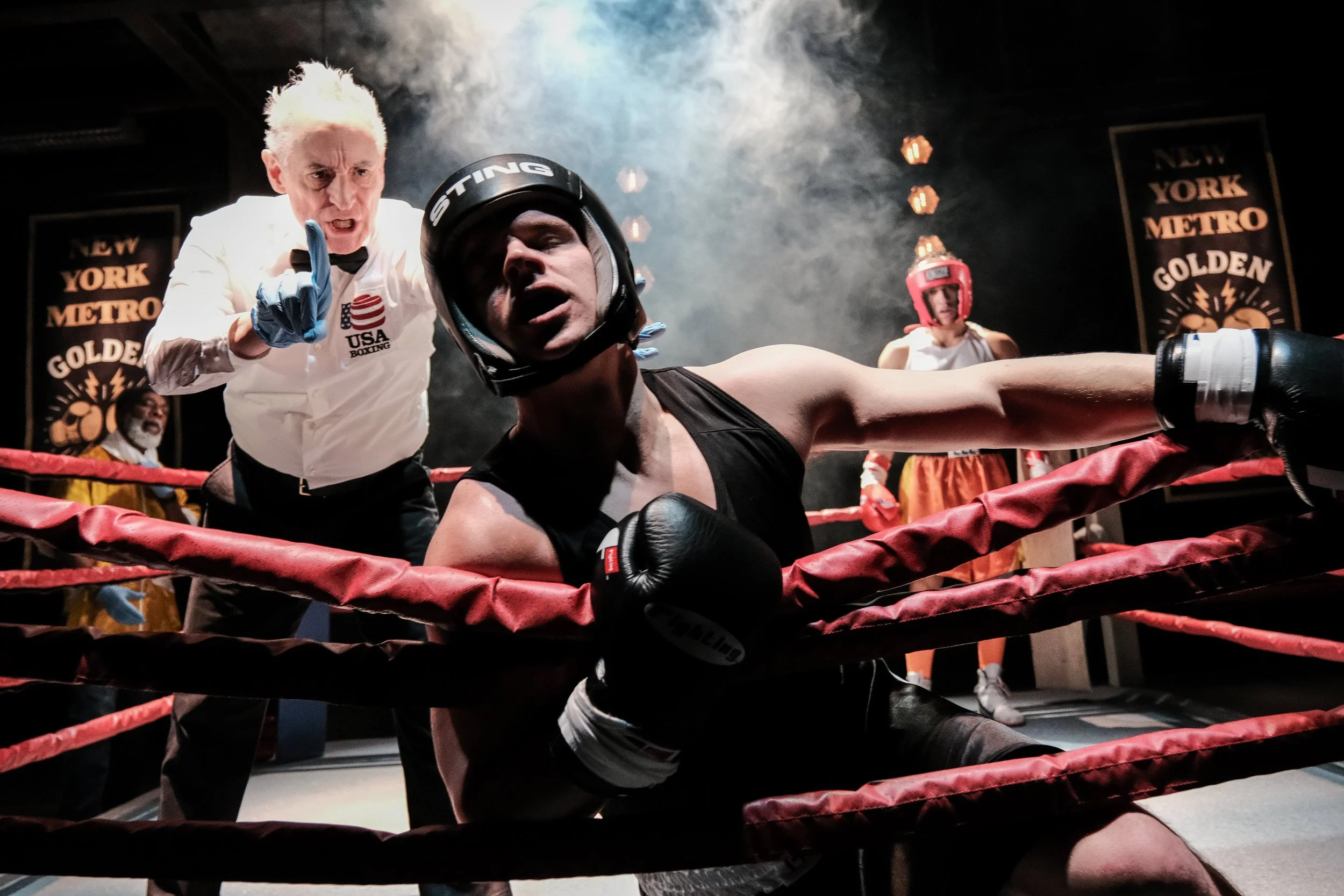
The world premiere production of Relentless by Rae Binstock at Syracuse Stage. Feb 4 - 22, 2026. Photo by Mike Davis. Courtesy by Syracuse Stage
On a stage that resembles the interior of an industrial-style boxing gym, a young man trains with a punching bag, wearing a golden jersey with "Wookie" printed on the back. An old man reclines in a chair beside the ring.
The round bell rings crisply.
Relentless invites the audience into its intense, sweat-dripping world just minutes before the official acts begin.
In this world premiere, playwright Rae Binstock draws on her experience at Gleason’s, a legendary boxing gym in the U.S. The production delivers a heartfelt love letter to this once-glorious, market-shrinking sport and its community.
Exploring the tension between carrying on a legacy and moving into the next chapter, the play opens with an immediate debate between ex-professional boxer Monique Jeffries (Rebecca S'manga Frank) and her former coach, Johnny Pierce (Jeorge Bennett Watson), about the types of training they offer at Bailey’s — a fictional version of Gleason’s.
Act one unfolds the central conflict when Monique accepts an offer from her wealthy Wall Street client, Matt Michaels (Stephen Michael Spencer), to renovate the gym into an elite boxing facility — a move Johnny fiercely opposes, and one that ultimately climaxes in a Golden Gloves showdown between their fighters Wookie (David Harrison Pralgo) and Matt in Act two.
The show brings screen-quality realism to Syracuse Stage, creating a 360-degree boxing immersion from the moment the 1:1 gym-replica set comes into view. The “hall of fame” above the lockers and a large sign honoring Monique’s IBF championship highlight the history and pride of Bailey’s. The actors’ punch moves and the sharp clang of the bell boost adrenaline. While almost all the details are precisely crafted, the applause sound effect sometimes doesn’t sync well with the fights and distracts from the authentic experience. The production team should leave the reaction to the audience — in fact, during a student-oriented show, some even stand to cheer for the fighters, as if they had forgotten it’s a play.
Most costumes are activewear, but they still clearly distinguish the characters. Johnny’s printed tops reflect his legacy-driven persona by referencing milestones in boxing history — whether it’s a red “1964 Miami” recalling the February night when Cassius Clay (later Muhammad Ali) stunned the world by defeating Sonny Liston, or a blue “ALI 1971” explicitly paying tribute to the Ali-Frazier “Fight of the Century.”
Besides fussing over his $900 peacoat, Spencer leaves a strong impression as Matt, vividly portraying this comedic white-collar role with layers of goofy physicality, especially in the moments when Monique “tortures” this slightly class‑proud client during training. The playwright deepens the character by letting him speak out Monique’s unarticulated longing through the line “you deserve more than legacy,” prompting her to listen to herself.
The play sets future power versus heritage pride, but it doesn’t define right and wrong; instead, it offers an inclusive message: what matters most is loyalty to one’s own heart. As Monique and Johnny take different routes, their love for and insistence on the sport are not unlike each other.
The production team also introduces a subplot that addresses boxing and domestic violence by examining the crimes of notorious boxers. While it is a meaningful attempt, the play offers no answer, leaving a paradox of self-defense.
What happens after Bailey’s renovation is also left open, which makes Relentless more like an intro to a TV show, and you want the next episode.

Among the noises: Is there still room for new ‘designers’?
“I’m not a fashion designer,” Pharrell Williams, creative director of Louis Vuitton menswear, said during his interview with Vogue China in 2024, “Creative director, for sure.”
As scholars such as Liroy Choufan analyze the rise of celebrity fashion designers through Williams’ case, Williams has already set his role apart from other designers who share the same title of 'creative director.’
This is a witty way of avoiding answering the doubt that many might have - why an entertainment superstar can become a “designer” for one of the top houses on the fashion pyramid.
Celebrity designers are no longer a new profession, but only a few are recognized with the capital D. Most simply sell their own persona.
Williams, instead of begging the designers to let him join the table, created his own and opened it to any “outsiders” like him — applying the same strategy in his interpretation of equity for people of color during the Vogue China interview.
Unlike other celebrities who seek the fashion system’s validation of the “D” title, Williams subtly redefined the hierarchy of fashion: the creative director is no longer just a fancier title for a fashion designer, but is now positioned above them, embodying a broader sociocultural vision.
Williams seems to have paved the way for ambitious creators who are not fashion majors, but the legitimization of a non-fashion-designer creative director applies only to people like him — celebrity fashion figures. After all, fashion is just one of their businesses.
Williams can continue making his music and holding shows while enjoying the dream-like feeling of leading a fashion empire, but we don’t see a single sign of relief on designer Jonathan Anderson’s face when he debuted his Dior womenswear collection this season.
The message behind this different level of pressure is that celebrities like Williams have the privilege to fail and leave fashion whenever they want, and slightly say, “I’m not a fashion designer.”
Celebrities who dedicated themselves to the fashion industry have struggled, not unlike the traditional designers. Victoria Beckham — former Posh Spice, one of the most famous “Wives and Girlfriends” of athletes, always in tabloids — has just staged another successful eponymous collection during the recently concluded, noisy Paris Fashion Week. This now-optimistic-looking brand might have died if Beckham hadn’t been stubborn to prove herself, whether during its 2016 debt crisis or before she presented her first 10 dresses in front of poker-faced journalists in September 2008.
Ironically, the celebrity whom the audience and media took least seriously treated the fashion industry most sincerely and has received Vogue’s approval for a designer title without a hyphen.
Williams, on the other hand, has consistently been a multihyphenate admired and praised by media outlets as a highly creative artist, a hitmaker, an ambitious and visionary entrepreneur, a master collaborator, and more. It’s hard to find negative comments on him before this Vuitton position.
Whatever Vuitton chooses to call this jaw‑dropping designer appointment — however they play with the word — Williams’s contract reads more like an advanced ambassadorial one. To say he aligns with Vuitton’s cultural vision is less accurate than saying he aligns with their attention strategy in this attention-economy system.
Leveraging attention to celebrities has been at the heart of fashion since the very beginning. From Empress Eugénie serving as Charles Frederick Worth’s walking billboard to the Oscars nearly becoming “The Armani Awards,” the attention that fashion attracted was part of what the audience gave to the celebrities.
But when key stakeholders frequently emphasized shifting from attention to retention at Business of Fashion’s 10th annual gathering - VOICES 2025, the fashion industry, the first beneficiary of the attention economy, finally has to battle with its own currency in this everyone-as-media era.
Modern Western fashion, born as “luxury” and once reserved for royals and socialites, took a gamble when it reached into the wallets of ordinary people, rebranding them with an elegant title: aspirational clients. What emerged was a seemingly flawless, sustainable model — selling exclusive products to the upper class, promoting them through figures who embody the illusions and desires of the masses, while stimulating the audiences to buy the brands’ mass-produced, more affordable pieces.
This dual strategy has shaped today’s luxury market, where mass audiences and the (ultra) high-net-worth elite almost equally drive revenue.
For decades, it worked pretty well, eventually propelling Bernard Arnault, chairman of LVMH, to the top of the world’s rich list — until the current moment of macroeconomic uncertainty.
The industry is clearly paying the price for stretching its reach too far.
After all, the model thrived on a spatiotemporal information gap between elites and the masses, who had little idea of each other’s real lives; the only bridge was the presence of celebrity images in mass media. Fashion brands poured glamour into those images, allowing audiences to project their ideal lives and selves and channel that longing into purchasing decisions.
Social media collapsed the information barriers. Attention, once the exclusive currency owned by celebrities, star designers, and media, is now openly circulated in the mass market. The shift to the creator economy caused an inflation of attention and ultimately challenged luxury fashion’s marketing strategy — selling dreams.
People from all income levels and regions can now easily compare designs and quality across brands, instantly share shopping experiences, and voice complaints about unreasonable prices on various social platforms. Luxury products are much more accessible to everyone; even if they don’t own one, they already understand their value and vanity.
Like the influencer Gstaad Guy said, “Consumers are getting smarter. Products are getting dumber.”
When customers realize that a high price doesn’t guarantee high quality and long-lasting value, luxury fashion becomes nothing more than an illusion.
Luxury fashion still claims to sell dreams and emotions, but customers now look for practicality — give me what is worth my money.
It’s a tough question for luxury fashion — even Prada CEO Andrea Guerra kept skating around customers’ doubts about the incompatibility of high fashion’s overstretching prices and their quality.
As big houses work to sort out their mess, there can be an opportunity for new designer brands to keep things simple and think small.
Instead of chasing social buzz or market share, aspirational designers can revisit what fashion creatives and craftsmen did centuries ago – make beautiful, high-quality products with a reasonable price point for their targeted audience. The unique stories are necessary packaging for each brand, but they are not the core.
Or if one is a multihyphenate like Williams, try to make even bigger noise than the powerhouses, and say, “I’m not a fashion designer, I am…” who knows, you may invent a new role that precedes the designer, just as Worth placed the designer above the tailor.